Why Is My Blood Sugar High Even When I Don't Eat Sugar?
I'll be honest — this is one of the most frustrating questions I hear, and I hear it almost every week. Someone cuts out the candy, swears off soda, says no to dessert at their grandkid's birthday party… and then the meter still flashes a number that makes their stomach drop. "I didn't eat any sugar. How is this possible?"
If that's you, take a breath. You're not doing anything wrong, and your meter probably isn't broken. The truth is that most of the sugar in your blood never came from the sugar bowl. Once you understand where it actually comes from, the whole thing stops feeling like a mystery — and you get a lot more control over it.
Let's walk through it together, the way I'd explain it to my own father at the kitchen table.
📋 In This Article
- The Big Myth: "Sugar in food = sugar in blood"
- Reason 1: Your Liver Makes Its Own Sugar
- Reason 2: "Hidden" Carbs Become Sugar
- Reason 3: Insulin Resistance — the Real Engine
- Reason 4: Stress, Poor Sleep & Illness
- Reason 5: The Dawn Phenomenon (Morning Highs)
- What the Numbers Actually Mean
- What You Can Actually Do About It
- Frequently Asked Questions
The Big Myth That Trips Everyone Up
Here's the mental picture most of us grew up with: you eat sugar, the sugar goes into your blood, and that's your blood sugar. Simple, right? The problem is it's mostly wrong.
Your body doesn't care whether glucose arrived as a chocolate bar or a slice of "healthy" whole-wheat toast. And — this is the part that surprises people — your body can manufacture its own sugar out of thin air, no eating required. So when your reading is high and you "didn't eat sugar," the question isn't really "where did this sugar come from?" It's "why isn't my body clearing it the way it should?"
That single shift in thinking is the key to everything else in this article. Let me show you the five real reasons.
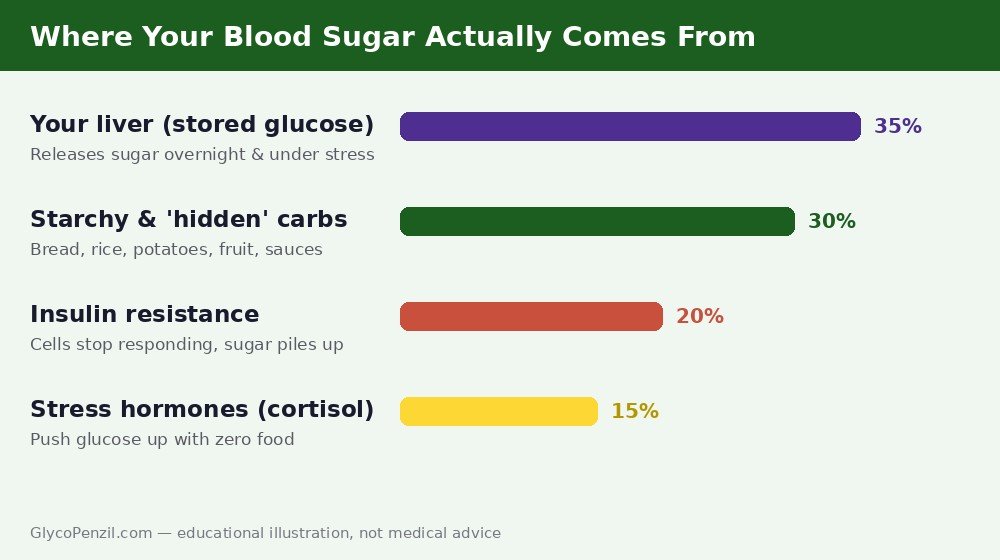
Most of your blood sugar isn't from sweets — it comes from your liver, starchy carbs, and how well your body handles insulin.
Reason 1: Your Liver Is a Little Sugar Factory
The liver releases glucose all day and all night
Your liver stores sugar (as something called glycogen) and quietly drips it into your bloodstream around the clock — especially while you sleep and between meals. This is a good thing: it's how your brain stays fueled when you haven't eaten for hours. The catch? In a healthy body, insulin tells the liver, "okay, that's enough, you can ease off now." When insulin isn't working well, the liver doesn't get the memo and keeps pumping sugar out. You wake up, you haven't eaten a bite, and your fasting number is still high. The food never entered the picture.
This is why so many people are baffled by their morning reading specifically. We'll come back to that one — it has its own name.
Reason 2: "I Didn't Eat Sugar" — But You Probably Ate Carbs
Starchy and "healthy" foods turn straight into glucose
Here's the one that catches almost everybody. Your digestive system breaks starchy carbohydrates down into glucose — the exact same sugar you'd get from a candy bar. To your bloodstream, a plain bagel can act a lot like several spoonfuls of table sugar.
Foods that feel "innocent" but spike blood sugar more than people expect:
- Bread, bagels, crackers — even the whole-grain kind
- Rice, pasta, potatoes — the comfort-food trio
- Breakfast cereal and instant oatmeal — often loaded with fast carbs
- Fruit and fruit juice — natural, yes, but still sugar to your blood
- "Sneaky" sauces and dressings — ketchup, BBQ sauce, teriyaki, sweetened yogurt
None of these are "sugar" in the way we usually think of it. But once they're digested, your body can't tell the difference. If your readings are high and you genuinely avoided sweets, the carbs on your plate are the first place I'd look.
💡 A simple test you can run at home
Check your blood sugar before a meal, then again about 2 hours after. If a "no-sugar" meal still sends you up by 40–50 points or more, the carbs in that meal — not your willpower — are the likely cause. This little experiment teaches you more about your own body than almost anything else.
Reason 3: Insulin Resistance — the Real Engine Behind It All
The lock-and-key system stops working
Think of insulin as a key that unlocks your cells so glucose can move out of the blood and get used for energy. With insulin resistance, the locks get "rusty." Your pancreas makes plenty of insulin, but the key doesn't turn easily anymore, so sugar piles up in the bloodstream with nowhere to go. This is the central problem in prediabetes and type 2 diabetes — and it explains why your blood sugar can stay stubbornly high even on days you barely ate.
Insulin resistance builds up quietly over years, which is exactly why it's so sneaky. You don't feel it happening. You just notice, one day, that the numbers don't add up — high readings that your diet alone can't explain. That's the engine running in the background.
Reason 4: Stress, Bad Sleep, and Being Under the Weather
Your body can raise blood sugar on command — no food required
This is the one people almost never suspect. When you're stressed, anxious, in pain, fighting a cold, or running on three hours of sleep, your body releases cortisol and adrenaline. Those hormones tell your liver, "release sugar, we might need to run!" — a survival reflex from our caveman days. The result? Your blood sugar climbs while you've eaten absolutely nothing.
I've seen people get a high fasting reading the morning after a rough night, panic, and assume their diabetes is "getting worse." Often it's just a bad night's sleep and a stressful week talking. It's real, but it's also manageable once you know it's happening.
⚕ Worth knowing
An infection, a steroid medication (like prednisone), surgery, or even significant pain can all push blood sugar up temporarily. If your numbers jump suddenly with no diet change, tell your doctor — there may be a simple explanation worth ruling out.
Reason 5: The "Dawn Phenomenon" — Why Mornings Are the Worst
If your highest reading of the day is the one you take right when you wake up — before coffee, before breakfast, before anything — you're in good company. This has a name: the dawn phenomenon.
In the early-morning hours (roughly 3 a.m. to 8 a.m.), your body releases a wave of hormones — cortisol, growth hormone, adrenaline — to help you wake up and get going. These hormones nudge your liver to release stored glucose so you've got energy for the day. In someone whose insulin works well, that little surge gets cleaned up automatically. But with insulin resistance, it doesn't, so you wake up to a higher number than you went to bed with. You didn't sleep-eat. Your body did exactly what it was designed to do — it just didn't clean up afterward.
💡 Three gentle things that help morning highs
A short evening walk after dinner, a protein-based snack instead of carbs before bed, and consistent sleep timing can all soften the dawn surge for many people. Small levers, real difference — and worth discussing with your provider.
What Do the Numbers Actually Mean?
Before you spiral over a single high reading, it helps to know where the lines are drawn. These are the standard ranges from the American Diabetes Association.
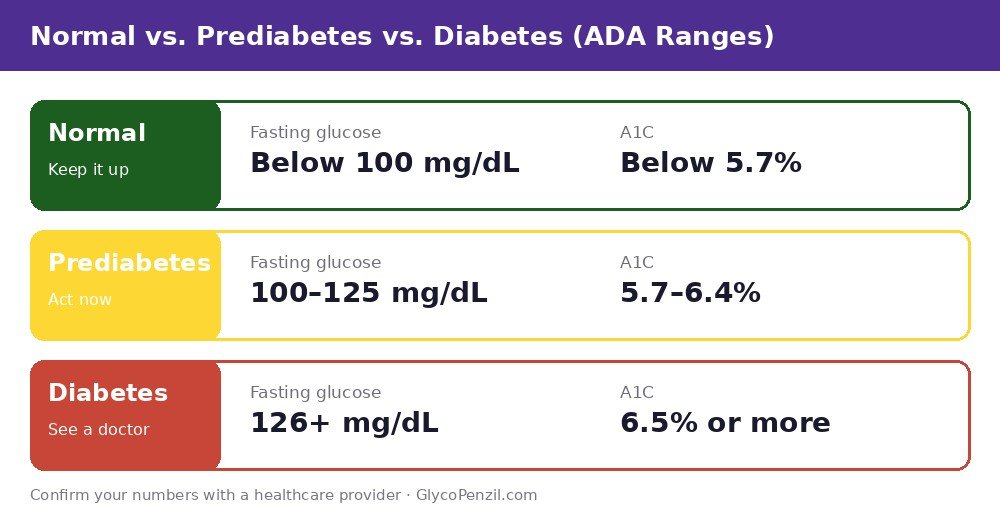
Fasting glucose and A1C ranges that separate normal, prediabetes, and diabetes. Confirm your own numbers with your provider.
| Category | Fasting Glucose | A1C | What it suggests |
|---|---|---|---|
| Normal | Below 100 mg/dL | Below 5.7% | Keep up your healthy habits |
| Prediabetes | 100–125 mg/dL | 5.7–6.4% | A clear, reversible warning |
| Diabetes | 126+ mg/dL | 6.5% or higher | Work closely with your doctor |
One number on one morning doesn't define you. What matters is the trend over weeks and months — and almost everything we've talked about (the liver, the carbs, the stress) is something you can influence.
What You Can Actually Do About It
Here's the encouraging part. Once you know the real sources, the fixes are surprisingly down-to-earth. None of this is a magic cure — it's just sensible, and it works for a lot of people.
1. Watch the carbs, not just the candy
Swap a few starchy servings for non-starchy vegetables, beans, eggs, fish, and nuts. You don't have to give up everything you love — even shrinking your portions of bread, rice and potatoes can move the needle.
2. Walk after you eat
A 10–15 minute stroll after meals lets your muscles pull glucose out of your blood without needing much insulin at all. It's one of the most underrated tools there is, and it's free.
3. Protect your sleep and manage stress
Seven to nine hours of decent sleep and a little daily stress relief — a walk, a hobby, time with people you like — directly lowers the cortisol that's been quietly raising your numbers.
4. Stay hydrated
When you're low on water, the sugar in your blood becomes more concentrated. A glass of water before meals is a small, easy win.
5. Consider researched support ingredients
Several natural ingredients have been studied for healthy glucose support — most notably berberine (sometimes called "nature's metformin"), along with cinnamon and resveratrol. They're not a substitute for the basics above or for your doctor's care, but many people use them alongside lifestyle changes.
Looking for Natural Daily Blood Sugar Support?
GlycoPezil™ brings together four of the most-studied natural ingredients for glucose support — Berberine HCL, Cinnamon Bark Extract, Resveratrol, and Manuka Honey — in one simple daily capsule. Made in the USA in an FDA-registered facility and backed by a 60-day money-back guarantee.
🛒 See GlycoPezil™ — Special Offer Today⭐⭐⭐⭐⭐ 4.9/5 from 1,840+ verified customers · 60-Day Money-Back Guarantee · Free US Shipping on 4+ Bottles
Frequently Asked Questions
Sources & further reading
- American Diabetes Association — Standards of Care; diagnostic criteria for prediabetes and diabetes (fasting glucose and A1C ranges).
- U.S. Centers for Disease Control and Prevention (CDC) — National Diabetes Statistics Report; prediabetes prevalence.
- National Institute of Diabetes and Digestive and Kidney Diseases (NIDDK) — insulin resistance and the role of the liver in glucose production.
- Mayo Clinic — the dawn phenomenon and morning high blood sugar.
- American Diabetes Association — stress, illness, and blood glucose.
📚 Also read: 10 Early Signs of Prediabetes You Should Never Ignore · 10 Warning Signs Your Blood Sugar May Be High · How to Lower A1C Naturally · 5 Daily Habits to Stabilize Blood Sugar