10 Early Signs of Prediabetes You Should Never Ignore
Let me start with the number that stops me cold every time: roughly 1 in 3 American adults has prediabetes — and more than 8 out of 10 of them have no idea. That's not a typo. Tens of millions of people are walking around with blood sugar that's already creeping up, feeling more or less fine, with no clue anything's off.
Here's the part I want you to hold onto, though: prediabetes is the one stage where the door is still wide open. It's a warning, not a sentence. Catch it early and, for a lot of people, it can be turned around. Miss it, and it quietly drifts toward type 2 diabetes over the years.
So the whole game is noticing. Below are 10 early signs I'd never want you to brush off. Some are obvious. A couple will probably surprise you. And one of them most people have never even heard of.
📋 The 10 Signs (Jump to Any)
- Constant thirst and dry mouth
- Needing to pee more often (especially at night)
- Bone-deep, unexplained fatigue
- Always hungry, even after eating
- Blurry vision that comes and goes
- Cuts and sores that heal slowly
- Tingling or numbness in hands and feet
- Frequent infections
- Dark, velvety skin patches
- Unexplained weight changes
- What the numbers mean & when to test
- Frequently Asked Questions
One quick note before we dive in: any single sign on its own usually isn't cause for alarm — we all get tired, we all get thirsty on a hot day. It's when two or three of these show up together and stick around that it's worth picking up the phone and booking a simple blood test.
Sign 1: You're Thirsty All the Time
Why it happens
Unquenchable thirst & a dry mouth
When blood sugar runs high, your kidneys go into overdrive trying to flush the extra glucose out through your urine. That pulls water from the rest of your body, leaving you genuinely dehydrated — so your brain screams "drink!" If you find yourself reaching for water, coffee, or anything to wet a constantly dry mouth and it never quite does the trick, that's a flag worth noting.
Sign 2: You're Running to the Bathroom More
Why it happens
Frequent urination — especially overnight
This is the flip side of the thirst. All that extra water your kidneys are using to dump glucose has to go somewhere. If you've started getting up two or three times a night when you used to sleep straight through, don't just chalk it up to "getting older." Excess sugar pulling fluid through your kidneys is a classic early signal, and the nighttime trips are often the first thing people notice.
Sign 3: You're Exhausted for No Good Reason
Why it happens
Tiredness that sleep doesn't fix
Here's the cruel irony of high blood sugar: there's plenty of fuel in your blood, but it can't get into your cells where it's actually needed. So your body is surrounded by energy it can't use — and you feel wiped out. If you're sleeping enough but still dragging through the afternoon, feeling foggy and flat, your blood sugar is one thing absolutely worth ruling out.
Sign 4: You're Hungry Again Right After Eating
Why it happens
Constant hunger, even on a full stomach
Same root cause as the fatigue. When glucose can't get into your cells, they send out an "I'm starving" signal — even though you just ate. Your body asks for more food, looking for energy it already has but can't reach. If you finish a real meal and feel hungry again within an hour or two, that's your cells crying out, not a lack of willpower.
Sign 5: Your Vision Goes Blurry, Then Clears
Why it happens
Blurry vision that comes and goes
High blood sugar can pull fluid into the lens of your eye, changing its shape and throwing off your focus. The blurriness often comes and goes as your sugar rises and falls. A lot of folks assume they just need new glasses — and they go get a prescription that's "off" a few weeks later. If your eyesight seems to shift day to day, mention it to your doctor before the optometrist.
Sign 6: Little Cuts and Sores Take Forever to Heal
Why it happens
Slow-healing wounds
Elevated blood sugar slows circulation and hampers the immune cells that do the repair work. A nick, a blister, a scrape on the shin that should clear up in a few days instead lingers for a week or two. Pay special attention to your feet here — slow healing on the feet is something to bring up with a provider promptly, not later.
Sign 7: Tingling or Numbness in Your Hands and Feet
Why it happens
Pins-and-needles or numbness
Even slightly elevated blood sugar, kept up over time, can start to irritate small nerves — most often in the hands and feet. People describe it as pins and needles, a faint burning, or patches that feel oddly numb. This is one of the more under-recognized early signs, and noticing it early gives you a real head start on protecting those nerves.
Sign 8: You Keep Catching Infections
Why it happens
Frequent or recurring infections
Higher sugar levels create a friendlier environment for bacteria and yeast, and they blunt the immune system at the same time. The tell-tale pattern is recurring trouble: repeat urinary tract infections, gum issues, slow-clearing skin or yeast infections. If you seem to be fighting something off more than your friends your age, it's worth asking why.
Sign 9: Dark, Velvety Patches of Skin
Why it happens
Acanthosis nigricans — the sign almost nobody knows
This is the one I really want you to remember, because most people have never heard of it. It's called acanthosis nigricans, and it shows up as darkened, thickened, almost velvety patches of skin — usually in the folds of the neck, the armpits, the groin, or knuckles. People often try to scrub it off thinking it's dirt. It isn't. It's one of the most visible outward signs of insulin resistance, and it deserves a doctor's eyes.
Sign 10: Unexplained Weight Changes
Why it happens
Weight shifting without a clear reason
This one cuts both ways. Some people gain weight, especially around the middle, as insulin resistance takes hold. Others lose weight without trying, because the body — unable to use glucose properly — starts burning muscle and fat for fuel instead. Either way, weight that changes notably without a change in your habits is your body telling you something. Listen to it.
⚠ When to seek care urgently
Prediabetes itself is rarely an emergency — but very high blood sugar can be. Get medical help right away if you notice fruity-smelling breath, confusion, rapid breathing, severe nausea or vomiting, or extreme drowsiness. These can signal a dangerous spike that needs immediate attention.
What the Numbers Mean — and When to Get Tested
Symptoms are clues. A blood test is the proof. Here's where the lines fall, using the American Diabetes Association's standard ranges.
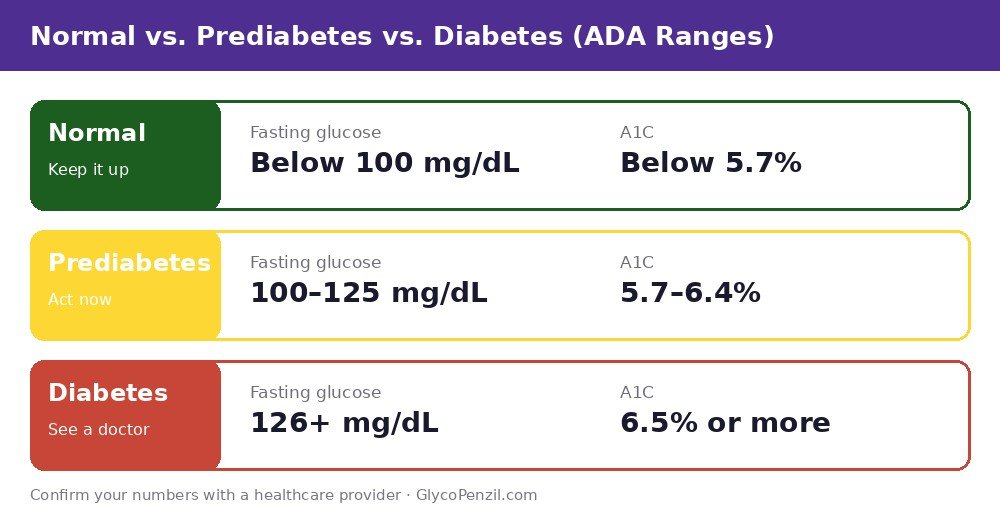
The prediabetes "in-between" zone — the window where blood sugar can often still be turned around.
| Test | Normal | Prediabetes | Diabetes |
|---|---|---|---|
| Fasting glucose | Below 100 mg/dL | 100–125 mg/dL | 126+ mg/dL |
| A1C | Below 5.7% | 5.7–6.4% | 6.5% or higher |
| 2-hr glucose tolerance | Below 140 mg/dL | 140–199 mg/dL | 200+ mg/dL |
💡 Who should ask for a test?
The general guidance is to start screening at age 45 — and earlier if you're overweight or have risk factors like a family history of diabetes, high blood pressure, or a mostly sedentary routine. A simple A1C or fasting glucose test is quick, cheap, and one of the most worthwhile favors you can do for your future self.
The Good News: This Stage Is Often Reversible
I don't want to leave you worried — I want to leave you equipped. Prediabetes responds beautifully to the basics: losing even a small amount of weight, walking most days (especially after meals), trading some starchy carbs for vegetables and protein, getting real sleep, and dialing down stress. Many people use these levers to bring their numbers back into the normal range entirely.
Some folks also lean on natural ingredients studied for glucose support — berberine chief among them, alongside cinnamon and resveratrol. These complement the lifestyle work; they don't replace it, and they don't replace your doctor. But they're part of the toolkit a lot of people reach for.
Support Healthy Blood Sugar — Naturally
GlycoPezil™ combines four of the most-studied natural ingredients for glucose support — Berberine HCL, Cinnamon Bark Extract, Resveratrol, and Manuka Honey — in one daily capsule. Made in the USA in an FDA-registered facility, backed by a 60-day money-back guarantee.
🛒 See GlycoPezil™ — Special Offer Today⭐⭐⭐⭐⭐ 4.9/5 from 1,840+ verified customers · 60-Day Money-Back Guarantee · Free US Shipping on 4+ Bottles
Frequently Asked Questions
Sources & further reading
- American Diabetes Association — Standards of Care; diagnostic criteria for prediabetes (fasting glucose, A1C, and oral glucose tolerance ranges).
- U.S. Centers for Disease Control and Prevention (CDC) — National Diabetes Statistics Report; prediabetes prevalence and awareness.
- National Institute of Diabetes and Digestive and Kidney Diseases (NIDDK) — symptoms and risk factors of prediabetes and insulin resistance.
- Mayo Clinic — prediabetes: symptoms, causes, and screening recommendations.
- American Academy of Dermatology — acanthosis nigricans and its link to insulin resistance.
📚 Also read: Why Is My Blood Sugar High Even When I Don't Eat Sugar? · 10 Warning Signs Your Blood Sugar May Be High · How to Lower A1C Naturally · Best Supplements to Lower Blood Sugar