Chromium for Blood Sugar Control: Benefits, Dosage, and Does It Really Work?
Chromium shows up on almost every blood-sugar supplement label — yet it is one of the most misunderstood ingredients in the category. Some people swear by it; others call it useless. The truth, as usual, sits in between. Chromium is an essential trace mineral your body genuinely needs for normal insulin function, and the research shows real (if modest) benefits — but only under the right conditions.
This guide gives you the honest answer: what chromium does, how much to take, which form actually absorbs, the side effects, and the blunt verdict on whether it really works.
📋 In This Article
What Is Chromium?
Chromium is a trace mineral found in foods like broccoli, whole grains, green beans, nuts, and brewer's yeast. The form your body uses — trivalent chromium (Cr3+) — is completely different from the toxic industrial form (hexavalent chromium). In nutrition, "chromium" always means the safe, dietary trivalent type.
Your body only needs tiny amounts, but those amounts matter: chromium is directly involved in how insulin moves glucose out of your blood and into your cells. When chromium is low, that process becomes less efficient.
Chromium is an essential trace mineral required for normal insulin signaling — but more is not always better.
How Chromium Works in the Body
Chromium's role centers on a compound historically called Glucose Tolerance Factor (GTF). In simple terms, chromium helps insulin do its job more effectively.
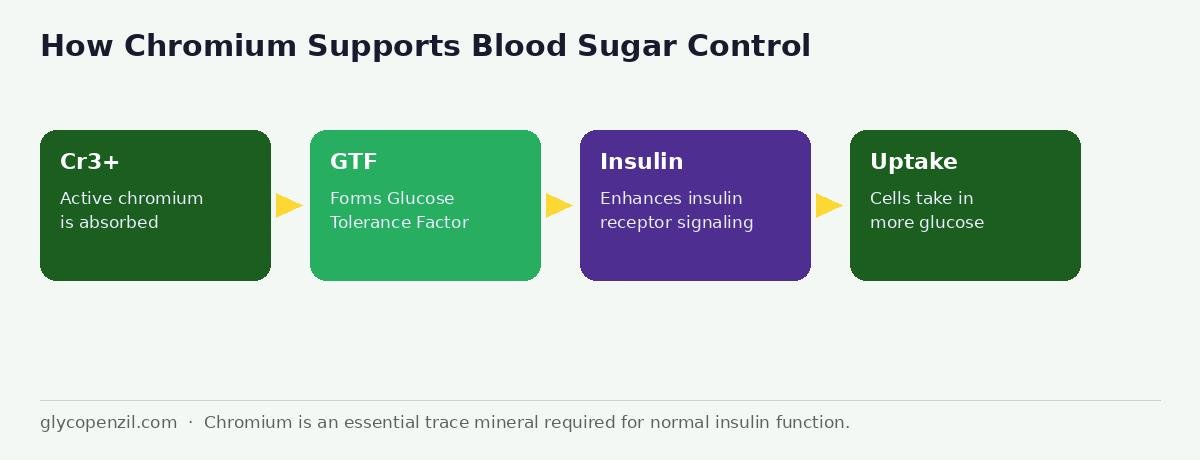
Chromium → GTF → enhanced insulin signaling → greater glucose uptake by cells.
Absorbed as Trivalent Chromium
Dietary chromium (Cr3+) is absorbed in small amounts and transported through the bloodstream bound to a protein.
Supports Insulin Signaling
Chromium enhances the activity of the insulin receptor, helping insulin bind and signal more effectively.
Improves Glucose Uptake
With insulin working more efficiently, cells take in more glucose from the blood, supporting steadier levels.
Benefits for Blood Sugar
The documented benefits of chromium are real but should be understood with realistic expectations.
1. Supports Insulin Sensitivity
Chromium's clearest role is helping insulin work better. This is most noticeable in people whose insulin response is already impaired.
2. May Lower Fasting Glucose & HbA1c
Several trials and pooled analyses report small reductions in fasting glucose and HbA1c, particularly in people with type 2 diabetes or poor baseline glucose control.
3. Helps Curb Carb & Sugar Cravings
Some studies link chromium supplementation to reduced cravings and appetite, which may indirectly support better glucose management and weight control.
4. Corrects a Genuine Deficiency
If you are low in chromium — more common in older adults, high-sugar diets, and during pregnancy or stress — supplementing restores a nutrient your insulin system depends on.
Does It Really Work? The Honest Verdict
Here is the straight answer most labels won't give you.
✅ Where Chromium Helps
The benefits are most reliable in people who are chromium-deficient or who have insulin resistance / type 2 diabetes. In these groups, supplementation can produce small but meaningful improvements in glucose control.
⚠️ Where It Disappoints
In people with normal chromium levels and healthy blood sugar, the effect is small and often not noticeable. Major reviews — including Cochrane analyses — have found the overall evidence mixed and modest, with effect sizes smaller than headline supplements like berberine. Chromium is a useful supporting nutrient, not a standalone solution.
The Evidence Consensus
Summary of meta-analyses and systematic reviews, 2007–2026
"Chromium supplementation shows modest improvements in glycemic markers, with the most consistent benefit observed in individuals with diabetes or chromium insufficiency. It is best positioned as one supportive component of a comprehensive approach rather than a primary therapy."
| Outcome | Strength of Evidence | Best Responders |
|---|---|---|
| Insulin sensitivity | Good | Insulin-resistant individuals |
| Fasting glucose / HbA1c | Modest | People with type 2 diabetes |
| Cravings / appetite | Modest | High-sugar diets |
| Effect in healthy people | Small | Limited noticeable benefit |
Which Form of Chromium Is Best?
Not all chromium is created equal. The form on the label dramatically affects how much your body can actually use.
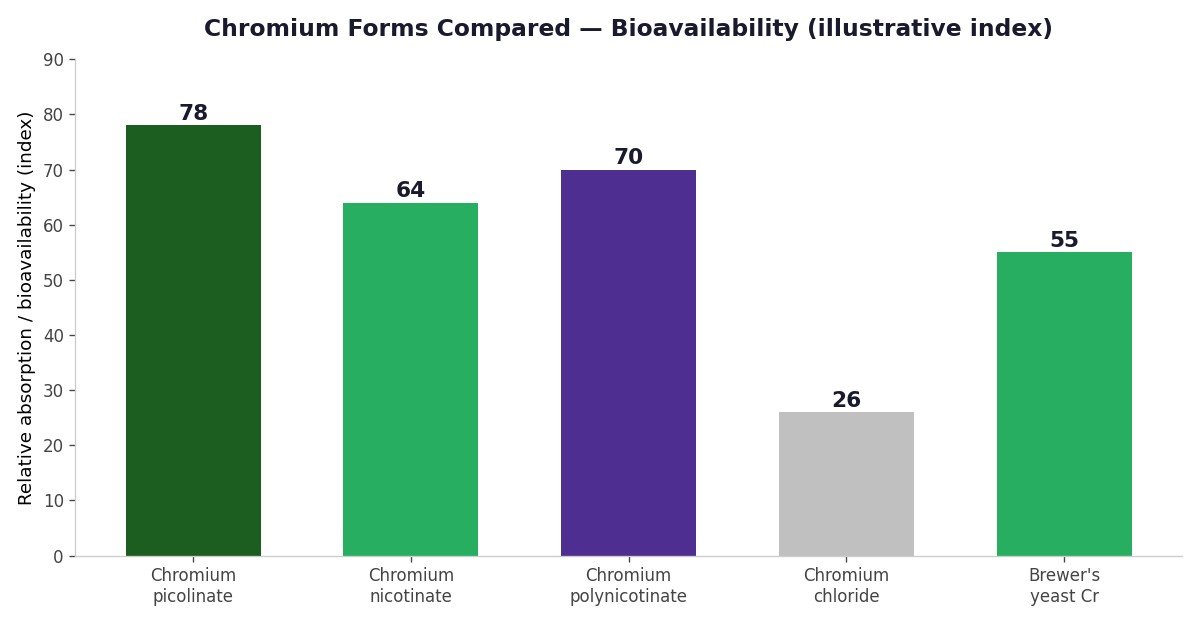
Chromium picolinate and polynicotinate absorb far better than chromium chloride (index values illustrative).
| Form | Absorption | Notes |
|---|---|---|
| Chromium picolinate | Best | Most studied form; used in most trials |
| Chromium polynicotinate | Very good | Bound to niacin; well absorbed |
| Chromium nicotinate | Good | Decent bioavailability |
| Brewer's yeast chromium | Moderate | Natural food-bound form |
| Chromium chloride | Poor | Cheap but poorly absorbed |
Dosage & How to Take It
| Goal | Typical Dose | How to Take |
|---|---|---|
| General glucose support | 200–600 mcg/day | With a meal, once daily |
| Type 2 diabetes (with doctor) | Up to 1,000 mcg/day | Split into 2 doses with meals |
| Maintenance / prevention | 200 mcg/day | With breakfast |
💡 Absorption Tip
Take chromium with food, and avoid taking it at the same time as calcium or antacids, which can reduce absorption. Vitamin C and niacin can modestly improve uptake. Consistency matters more than megadosing — higher is not better.
Side Effects & Safety
At typical supplement doses, chromium is considered safe and well tolerated. Side effects are uncommon and usually mild.
| Side Effect | Frequency | Notes |
|---|---|---|
| Headache | Uncommon | Usually mild and transient |
| Mild digestive upset | Uncommon | Take with food to reduce |
| Dizziness / mood changes | Rare | Reported at very high doses |
| Hypoglycemia | Rare | Possible if combined with diabetes meds |
⚠️ Use Caution If You…
…have kidney or liver disease, take diabetes medication (chromium may add to glucose-lowering effects), are pregnant or breastfeeding, or take thyroid medication or antacids. Always talk to your doctor before adding chromium if any of these apply.
Who Benefits Most From Chromium?
- People with insulin resistance or type 2 diabetes — the clearest responders.
- Older adults — chromium status tends to decline with age.
- People eating a high-sugar, refined-carb diet — which depletes chromium.
- Those with strong sugar cravings — some find cravings ease.
- People low in chromium — the most likely to see real improvement.
If you are already healthy with normal blood sugar, chromium alone is unlikely to be transformative — which is exactly why it works best combined with other ingredients.
Chromium Inside a Complete Formula
Chromium's strength — and its weakness — is that it does one specific job: helping insulin work. On its own, that single action produces modest results. But pair it with ingredients that tackle glucose from other angles, and the whole becomes greater than the sum of its parts.
That multi-pathway philosophy is the foundation of GlycoPezil™. Rather than leaning on one mineral, it anchors its formula in Berberine HCL and layers in complementary, research-supported ingredients.
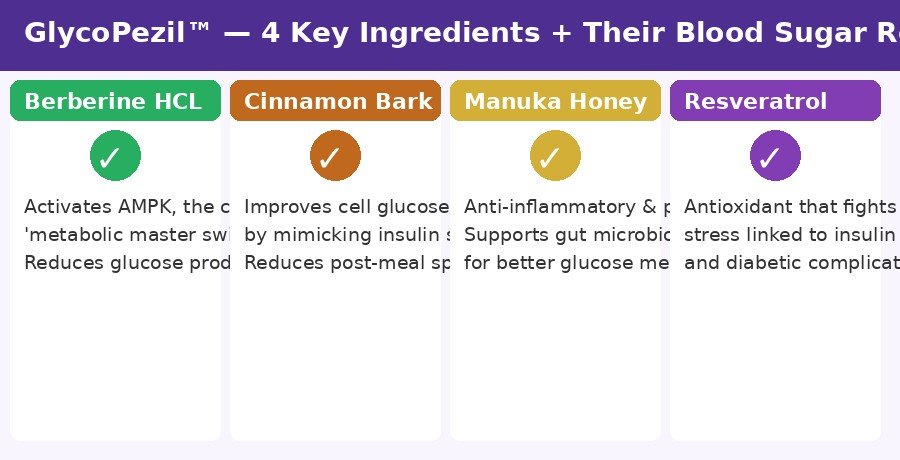
GlycoPezil™ supports blood sugar through several complementary pathways instead of relying on a single nutrient.
🌿 Berberine HCL
The anchor ingredient — activates AMPK, lowers liver glucose output, and improves insulin sensitivity. The most studied natural compound for blood sugar.
★★★★★ High Evidence🌿 Cinnamon Bark Extract
Supports insulin signaling and helps blunt post-meal glucose spikes — a different mechanism than chromium.
★★★★☆ Strong Evidence🍯 Manuka Honey
A prebiotic with anti-inflammatory properties that supports gut and metabolic health.
★★★☆☆ Moderate Evidence🍇 Resveratrol
An antioxidant that targets the oxidative stress and inflammation underlying insulin resistance.
★★★★☆ Growing EvidenceThe lesson chromium teaches is the case for a complete formula: support insulin function, but also address spikes, inflammation, and gut health at the same time.
Support Blood Sugar the Complete Way
Instead of relying on one mineral, GlycoPezil™ combines clinically studied ingredients into a single multi-pathway daily formula. Limited-time pricing is available now.
See GlycoPezil™ Pricing →60-Day Satisfaction Guarantee · Free Shipping Available · 100% Natural Formula
Frequently Asked Questions
📚 Continue Reading
→ Best Supplements to Lower Blood Sugar (2026): Ranked by Clinical Evidence
→ Berberine for Blood Sugar: Benefits, Side Effects & What Research Really Says
→ How to Lower A1C Naturally: 7 Evidence-Based Strategies
→ 5 Daily Habits That Stabilize Blood Sugar All Day
Want blood sugar support that goes beyond a single mineral?
Visit GlycoPezil™ Official Site →