Berberine for Blood Sugar: Benefits, Side Effects, and What Research Really Says
Berberine has quietly become the most talked-about natural ingredient for blood sugar — praised on YouTube as "nature's Ozempic," stacked in dozens of supplements, and studied in more clinical trials than almost any other botanical compound. But hype and evidence are not the same thing. So this guide does something most articles skip: it separates what berberine can do from what it cannot, looks honestly at the side effects, and shows you what the actual research — not the marketing — really says in 2026.
By the end you will know the real, documented benefits, the dosage clinical studies use, who should be careful, and how berberine fits into a complete blood sugar formula like GlycoPezil™.
📋 In This Article
What Is Berberine?
Berberine is a bright-yellow alkaloid found in several plants, including barberry (Berberis aristata), goldenseal, Oregon grape, and Chinese goldthread. It has been used in Traditional Chinese and Ayurvedic medicine for more than two thousand years — but modern interest exploded once researchers realized it acts on the same cellular pathway as one of the most prescribed diabetes drugs in the world.
Berberine is the single most-searched natural blood sugar ingredient in 2025–2026 — and one of the most clinically studied.
🔬 The Core Mechanism
Berberine activates AMP-activated protein kinase (AMPK) — the body's "metabolic master switch." Activating AMPK improves insulin sensitivity, reduces glucose production in the liver, and increases how much sugar your cells pull out of the bloodstream. This is the same pathway exercise stimulates and the same one metformin targets.
6 Evidence-Backed Benefits of Berberine
When you strip away the social-media exaggeration, berberine still has a genuinely impressive evidence base. Here are the six benefits with the strongest research support.
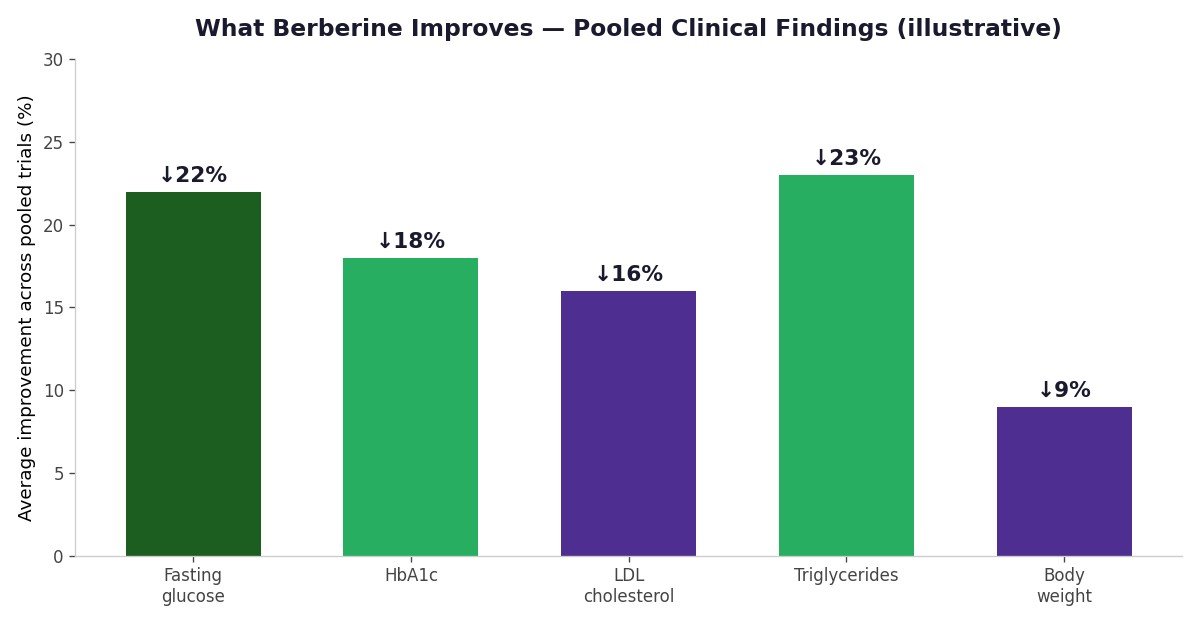
Pooled clinical findings show berberine's effects extend beyond glucose to lipids and weight (figures illustrative of averaged trial results).
1. Lower Fasting Blood Glucose
This is berberine's best-documented effect. Across pooled trials, berberine consistently reduced fasting plasma glucose, with the largest benefits seen in people who started with elevated levels.
2. Reduced HbA1c (3-Month Average)
HbA1c reflects your average blood sugar over roughly three months. Multiple meta-analyses report meaningful HbA1c reductions with berberine, in a range frequently described as comparable to standard first-line therapy.
3. Improved Insulin Sensitivity
By activating AMPK and increasing insulin-receptor responsiveness, berberine helps cells respond to insulin more efficiently — addressing one of the root drivers of high blood sugar rather than just the symptom.
4. Better Cholesterol & Triglycerides
Berberine is unusual among glucose supplements because it also acts on lipids. Studies report reductions in LDL ("bad") cholesterol and triglycerides — a benefit that prescription glucose drugs generally do not provide.
5. A Healthier Gut Microbiome
Berberine reshapes gut bacteria in ways that appear to support metabolic health. This dual action — cellular plus microbial — is part of why its effects are broader than a single-target drug.
6. Modest Weight Support
Several trials note small reductions in body weight and waist circumference, likely secondary to improved insulin sensitivity. The effect is real but modest — berberine is not a weight-loss shortcut.
What the Research Really Says
Here is the honest picture — the part most marketing pages leave out.
The headline evidence is a 2022 meta-analysis published in Frontiers in Pharmacology that pooled 37 randomized controlled trials covering 3,048 participants. It concluded that berberine produced clinically meaningful reductions in fasting glucose and HbA1c, frequently rivaling metformin. That is a strong result and the reason berberine is taken seriously by researchers, not just influencers.
⚠️ But Read the Fine Print
Many berberine trials are small, short (8–12 weeks), and conducted in specific populations — often people who already have elevated glucose. The benefits are most reliable in those groups. In people with already-normal blood sugar, effects are smaller. Long-term safety data beyond six months is still limited, and trial quality varies. Berberine is promising and well-studied — but it is a supportive tool, not a cure.
| Outcome | Strength of Evidence | What It Means For You |
|---|---|---|
| Fasting glucose reduction | Strong | Most consistent benefit across trials |
| HbA1c reduction | Strong | Meaningful over 8–12 weeks of use |
| Insulin sensitivity | Good | Addresses an underlying driver |
| Cholesterol / triglycerides | Good | A useful bonus most drugs lack |
| Weight loss | Modest | Small effect — not a primary use |
| Long-term safety (1+ year) | Limited | Cycling and supervision advised |
The Researcher's Consensus
Summary of pooled meta-analytic findings, 2022–2026
"Berberine demonstrates a hypoglycemic effect comparable to oral antidiabetic agents in several pooled analyses, with additional favorable effects on lipid profiles. It is best viewed as an evidence-supported adjunct alongside diet and lifestyle — not a replacement for prescribed care."
How Berberine Works in the Body
Activates AMPK
Berberine switches on AMP-activated protein kinase, the enzyme that signals your cells to burn fuel and improve insulin response — the same switch flipped by exercise.
Reduces Liver Glucose Output
It lowers hepatic gluconeogenesis — the liver's tendency to dump extra sugar into the blood, especially overnight and between meals.
Improves Cellular Glucose Uptake
By increasing insulin-receptor sensitivity, more glucose moves out of the bloodstream and into cells where it is used for energy.
Rebalances the Gut Microbiome
Berberine shifts gut bacteria toward strains associated with better metabolic markers, adding a second, independent route to glucose support.
Side Effects & Safety
Berberine is generally well tolerated, but it is not side-effect-free. The good news: almost all reported issues are digestive, mild, and fade as your body adjusts.
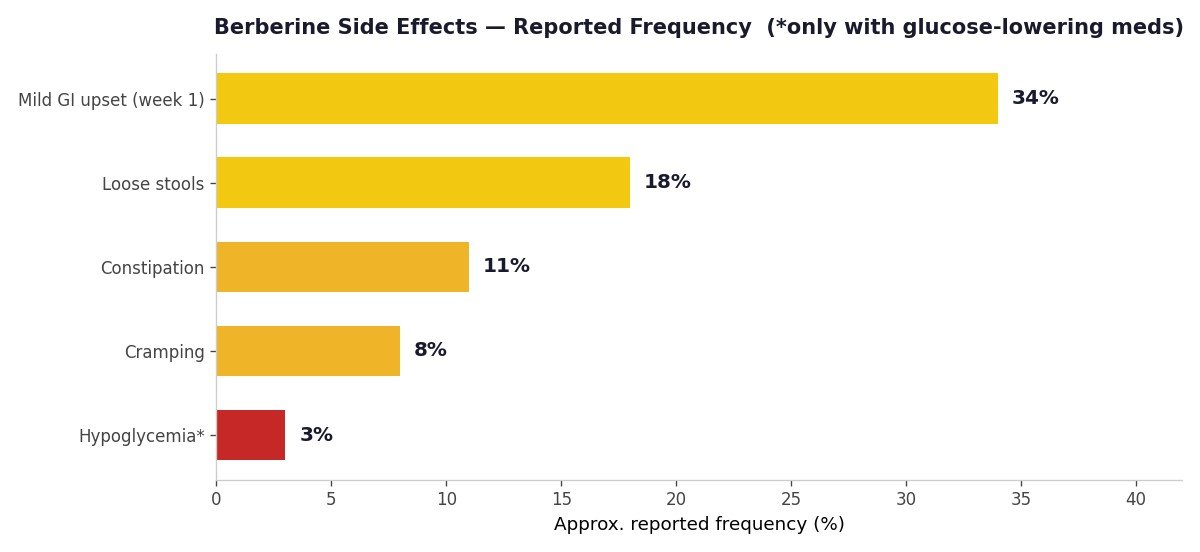
Most berberine side effects are gastrointestinal and concentrated in the first week of use.
| Side Effect | Frequency | How to Minimize |
|---|---|---|
| Nausea / GI discomfort | Most common (week 1) | Take with food; start at a lower dose |
| Loose stools / diarrhea | Occasional | Split into smaller doses with meals |
| Constipation | Less common | Increase water and fiber intake |
| Cramping / bloating | Occasional | Usually resolves within 1–2 weeks |
| Hypoglycemia (low sugar) | Rare — only with glucose meds | Monitor glucose; tell your doctor |
Optimal Dosage & Timing
Because berberine has a short half-life, how you take it matters as much as how much. Splitting the dose keeps levels steady throughout the day.
| Goal | Typical Clinical Dose | Timing |
|---|---|---|
| General glucose support | 1,000–1,500 mg/day total | 500 mg, 2–3× daily with meals |
| Sensitive stomach / new users | Start at 500 mg/day | Once daily with the largest meal |
| Lipid + glucose support | 1,500 mg/day | Split across 3 meals |
💡 Pro Tip From the Research
Berberine absorbs best when taken with a meal that contains some fat. Taking it on an empty stomach increases stomach upset and lowers absorption. Many practitioners suggest cycling — roughly 8 weeks on, 2–4 weeks off — to maintain effectiveness over the long term.
Who Should Be Careful
- Pregnant or breastfeeding women — avoid; berberine may affect fetal development and can cross into breast milk.
- People on metformin or insulin — combining can lower glucose too far; monitor closely with your doctor.
- Anyone taking blood thinners (e.g., warfarin) — possible interaction.
- People on medications processed by CYP3A4/CYP2D6 enzymes — berberine can alter how these drugs are metabolized.
- Newborns — berberine should never be given to infants.
What Results to Expect & When
Days 1–7: Adjustment Phase
The gut adapts and AMPK activation begins. Mild digestive changes are normal. Take with food to ease the transition.
Weeks 2–3: Fasting Glucose Trends Down
Liver glucose output begins to fall and insulin sensitivity improves. Many users notice steadier energy after meals.
Weeks 4–6: Measurable Change
Clearer improvements in fasting numbers. Lipid markers may begin shifting favorably.
Weeks 8–12: Peak Effect
Maximum cumulative benefit. This is when an HbA1c retest typically reflects the biggest change.
Berberine Inside a Complete Formula
Here is the practical limitation of standalone berberine: it targets glucose through one main route. The research increasingly shows that pairing berberine with complementary ingredients produces broader, more consistent support — covering post-meal spikes, oxidative stress, and gut health that berberine alone cannot fully address.
This is the logic behind GlycoPezil™, which is built around Berberine HCL and then layers in three research-supported partners.
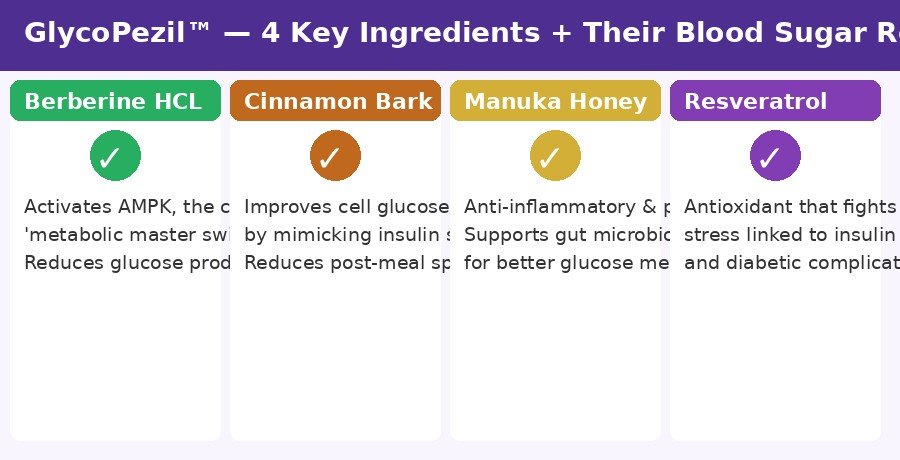
GlycoPezil™ pairs Berberine HCL with three complementary ingredients to support blood sugar through multiple pathways.
🌿 Berberine HCL
The anchor. Activates AMPK, reduces liver glucose output, and improves insulin sensitivity — the most studied natural compound for blood sugar.
★★★★★ High Evidence🌿 Cinnamon Bark Extract
Helps blunt post-meal glucose spikes by supporting insulin signaling — covering a window berberine handles less directly.
★★★★☆ Strong Evidence🍯 Manuka Honey
A prebiotic with anti-inflammatory properties that supports the same gut microbiome berberine reshapes.
★★★☆☆ Moderate Evidence🍇 Resveratrol
An antioxidant that targets the oxidative stress and inflammation tied to insulin resistance — protecting long-term cellular health.
★★★★☆ Growing EvidenceThe takeaway is simple: berberine is excellent, but it works best as the foundation of a multi-pathway approach rather than in isolation.
Berberine — Done the Complete Way
GlycoPezil™ delivers clinically studied Berberine HCL plus three synergistic co-ingredients in one daily formula. Limited-time pricing is available now.
See GlycoPezil™ Pricing →60-Day Satisfaction Guarantee · Free Shipping Available · 100% Natural Formula
Frequently Asked Questions
📚 Continue Reading
→ Berberine: Is It Really "Nature's Ozempic"? The Honest Verdict
→ Berberine & Blood Sugar: Dr. Mark Hyman's Evidence-Based Protocol (2026)
→ Best Supplements to Lower Blood Sugar (2026): Ranked by Clinical Evidence
→ How to Lower A1C Naturally: 7 Evidence-Based Strategies
→ Manuka Honey & Blood Sugar: The Science Explained
Looking for a natural formula built around Berberine HCL + Cinnamon + Manuka + Resveratrol?
Visit GlycoPezil™ Official Site →