Berberine: Is It Really "Nature's Ozempic"?
Scroll through TikTok or Instagram for five minutes and you'll meet it: a bright yellow capsule sold as a cheap, natural stand-in for Ozempic. The nickname stuck — "nature's Ozempic" — and suddenly berberine, a compound used in traditional medicine for over 2,000 years, became a social-media superstar.
So is it true? Can a supplement really do what a prescription weight-loss injection does? The honest answer is more nuanced than either the hype videos or the dismissive headlines suggest. Let's separate the marketing from the actual research — including who berberine genuinely helps, and who's likely to be disappointed.
📋 In This Article
Where the "Nature's Ozempic" Label Came From
The label was born from a real problem. Semaglutide — the active ingredient in Ozempic and Wegovy — became enormously popular for weight loss, but its cost and supply shortages put it out of reach for many people. Into that gap stepped a cheap, over-the-counter alternative that promised some of the same metabolic magic.
Berberine had two things going for it: a genuine, well-documented effect on blood sugar, and a bright-yellow "natural medicine" story that's perfect for short videos. The nickname did the rest. But a catchy name isn't a clinical claim — and that's where the two part ways.

The "nature's Ozempic" nickname is marketing — berberine and semaglutide work in very different ways.
How Berberine and Ozempic Actually Differ
This is the heart of it. Both can influence weight, but the way they get there isn't remotely the same — and that difference explains why the results aren't either.
Ozempic works on appetite (GLP-1)
Semaglutide mimics GLP-1, a gut hormone released after eating. It slows stomach emptying and signals fullness to the brain, so you eat noticeably less. That appetite effect is why the weight loss can be substantial.
Berberine works on metabolism (AMPK)
Berberine activates AMPK — often called the body's "metabolic master switch" — and improves insulin sensitivity. It nudges how your body handles glucose and energy. It is not primarily an appetite suppressant.
The result gap
Because berberine doesn't curb appetite the way a GLP-1 drug does, any weight effect tends to be indirect — flowing from better blood sugar control rather than from eating dramatically less.
| Factor | Berberine | Ozempic (semaglutide) |
|---|---|---|
| Type | Dietary supplement | Prescription medication |
| Main mechanism | AMPK + insulin sensitivity | GLP-1 appetite control |
| Typical weight effect | Modest (a few pounds) | Substantial |
| Evidence quality | Small, short studies | Large clinical trials |
| Cost | Low | High |
| Best-supported use | Blood sugar support | Diabetes & weight management |
What the Weight-Loss Research Really Shows
Here's where honesty matters most. The weight-loss studies on berberine are real — but they're small, short, and modest in their findings.

Across small trials, berberine's average weight change clusters in the low single digits to about 10 pounds. Values illustrative of published study ranges.
Reviews from major academic medical centers land in roughly the same place. Preliminary research suggests berberine may reduce weight, BMI and waist circumference in people in the overweight range — but mostly in studies using around 1 gram daily for at least eight weeks. In one small study, people with obesity taking 500 mg three times a day for 12 weeks lost about five pounds on average.
The Evidence Consensus
Summary of academic medical-center reviews, 2023–2026
"Berberine may support metabolic markers and modestly improve some obesity indices, but it is not an Ozempic replacement — and the evidence base is small and lower-quality. A more accurate frame is that berberine is a metabolic-support supplement that may help some people a little, especially when blood sugar or insulin resistance is part of the picture."
The Honest Verdict
✅ What berberine genuinely does
It has solid evidence for supporting healthy blood sugar and insulin sensitivity. Any weight benefit is real but small, and tends to follow from that metabolic effect — not from suppressing appetite.
⚠️ Where the hype falls apart
Berberine is not a natural version of Ozempic. It doesn't work the same way, the weight loss is a fraction of the size, the studies are short and small, and it carries real interactions. Calling it "nature's Ozempic" oversells it.
The fairest way to think about berberine: it's one of the best-studied natural compounds for blood sugar, with a mild bonus effect on weight for some people. That's genuinely useful — it just isn't a miracle, and it isn't a drug.
Who Berberine Actually Suits
- People focused on blood sugar — this is berberine's strongest, best-supported use.
- Those with insulin resistance or prediabetes — the group most likely to see a metabolic benefit.
- People wanting modest, realistic support — not a dramatic weight-loss result.
- Those who can take it consistently — effects build over weeks, not days.
It suits less well anyone expecting it to replace a prescribed medication, anyone seeking large or fast weight loss, or anyone on medications that interact with it (more on that below).
Dosage & How to Take It
| Goal | Typical Dose | How to Take |
|---|---|---|
| Blood sugar support | 500 mg, 2–3× daily | With meals (total 1,000–1,500 mg/day) |
| Metabolic / weight support | ~1,000 mg/day | Split across meals, 8+ weeks |
| Sensitive stomach | Start at 500 mg/day | Build up slowly to reduce GI upset |
💡 Why it's split into multiple doses
Berberine has a short half-life, so taking it once a day wastes most of it. Splitting the dose across meals keeps levels steadier and improves tolerability — taking it with food also softens the most common side effect: digestive upset.
Safety, Side Effects & Interactions
Berberine is generally well tolerated short-term, but "natural" doesn't mean risk-free — and this is where the social-media version skips the fine print.
| Concern | Frequency | Notes |
|---|---|---|
| Digestive upset (cramping, diarrhea) | Common | Worst at high doses; take with food |
| Constipation or nausea | Uncommon | Usually eases with a lower dose |
| Low blood sugar | Possible | Risk rises if combined with diabetes meds |
| Drug interactions | Important | Affects liver-metabolized medications |
⚠️ Talk to your doctor first if you…
…take any prescription medication (berberine can interact with drugs processed by the liver), take diabetes medication, are pregnant or breastfeeding (berberine is not recommended), or have a liver condition. Never stop or replace a prescribed medication with a supplement on your own.
Berberine Done Right
Here's the practical problem the trend creates: people grab the cheapest single-ingredient berberine they can find, take it once a day, give up when their stomach rebels or the scale barely moves, and conclude it "doesn't work." Most of those failures are about how it was used, not the compound itself.
Berberine performs best as the anchor of a thoughtful, multi-pathway formula — paired with ingredients that cover what it can't, at sensible doses. That's the principle behind GlycoPezil™: it leads with Berberine HCL, then layers in complementary support so blood sugar is addressed from several angles instead of one.
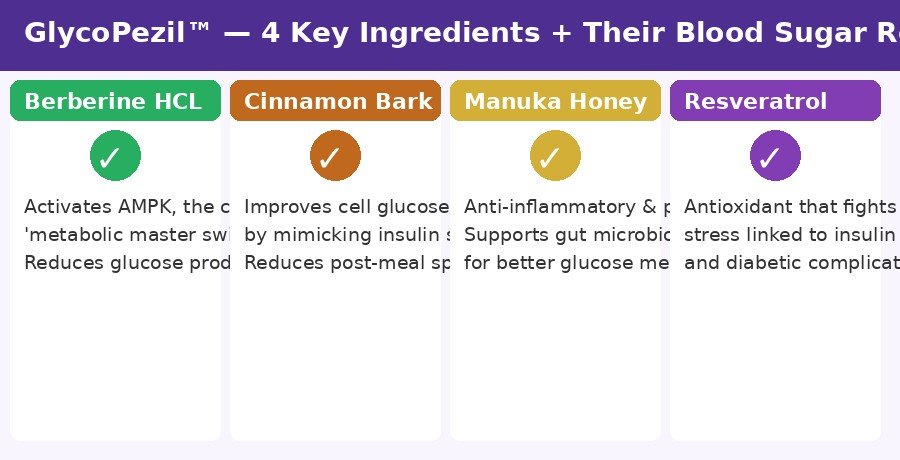
GlycoPezil™ anchors on berberine and supports blood sugar through several complementary pathways.
🌿 Berberine HCL
The anchor — activates AMPK, lowers liver glucose output and improves insulin sensitivity. The most studied natural compound for blood sugar.
★★★★★ High Evidence🌿 Cinnamon Bark Extract
Supports insulin signaling and helps blunt the post-meal glucose spikes berberine alone doesn't fully cover.
★★★★☆ Strong Evidence🍯 Manuka Honey
A prebiotic with anti-inflammatory properties that supports gut and metabolic health.
★★★☆☆ Moderate Evidence🍇 Resveratrol
An antioxidant targeting the oxidative stress and inflammation behind insulin resistance.
★★★★☆ Growing EvidenceIt's an honest way to use a genuinely useful ingredient: realistic expectations, the right dose, and the support that helps berberine do its actual job — steadying blood sugar — rather than chasing an Ozempic result it was never going to deliver.
Berberine, the Smart Way
GlycoPezil™ anchors on Berberine HCL and combines it with clinically studied ingredients in one daily multi-pathway formula — built for steady blood sugar support, not hype. Limited-time pricing is available now.
See GlycoPezil™ Pricing →60-Day Satisfaction Guarantee · Free Shipping Available · 100% Natural Formula
Frequently Asked Questions
📚 Continue Reading
→ Berberine for Blood Sugar: Benefits, Side Effects & What Research Really Says
→ Berberine & Blood Sugar: Dr. Mark Hyman's Evidence-Based Protocol
→ Best Supplements to Lower Blood Sugar (2026): Ranked by Evidence
→ 15 Foods That Lower Blood Sugar Naturally (2026)
Want berberine used the right way — anchored in a complete formula?
Visit GlycoPezil™ Official Site →