Berberine & Blood Sugar: Dr. Mark Hyman's Evidence-Based Protocol — and How GlycoPezil™ Delivers It
If you have been searching for a natural way to support healthy blood sugar, you have almost certainly come across berberine. It is the most-searched blood sugar supplement ingredient on the internet in 2025–2026 — and for good reason. A growing mountain of clinical research confirms what functional medicine pioneer Dr. Mark Hyman has said for years: berberine may be nature's most powerful tool for glucose regulation.
In this guide, we break down exactly what the science says, how berberine compares to prescription metformin, what the optimal dose looks like, and why GlycoPezil™ uses Berberine HCL as its anchor ingredient.
📋 In This Article
- What Is Berberine?
- Dr. Mark Hyman on Berberine
- Clinical Evidence (2022–2026)
- Berberine vs. Metformin: Full Comparison
- 5 Mechanisms: How It Works in the Body
- Optimal Dosage & Timing
- Side Effects & Who Should Be Careful
- How Fast Can You Expect Results?
- GlycoPezil™: Berberine + 3 Synergistic Partners
- Frequently Asked Questions
What Is Berberine? The Plant Alkaloid Taking the Medical World by Storm
Berberine is a natural alkaloid compound found in several plants, including Berberis aristata (barberry), goldenseal, Oregon grape, and Chinese goldthread. It has been used in Traditional Chinese Medicine for over 2,000 years to treat infections and digestive disorders — but it is its remarkable effects on blood sugar that have captured modern science's attention.
The compound has a distinctive bright yellow color and works on a cellular level through a mechanism scientists call AMPK activation — the same pathway that exercise stimulates, and the same one targeted by metformin.
Berberine is the #1 most-searched natural blood sugar ingredient in 2025–2026, backed by 37+ randomized controlled trials.
🔬 Key Scientific Fact
Berberine activates AMP-activated protein kinase (AMPK), often called the body's "metabolic master switch." When AMPK is activated, it improves insulin sensitivity, reduces glucose production in the liver, and increases cellular glucose uptake — all critical for blood sugar control. Metformin works through this exact same mechanism.
Dr. Mark Hyman's Position on Berberine
Dr. Mark Hyman, one of America's most prominent functional medicine physicians, has been among the strongest clinical advocates for berberine. As the founder of the Cleveland Clinic Center for Functional Medicine, 14× New York Times bestselling author, and author of The Blood Sugar Solution, Dr. Hyman has used berberine as a cornerstone recommendation for patients managing diabetes, prediabetes, and metabolic syndrome — especially those who prefer not to take metformin.
Dr. Mark Hyman, MD
Founder, Cleveland Clinic Center for Functional Medicine · 14× NYT Bestselling Author · Author of "The Blood Sugar Solution"
"Berberine is one of the most powerful natural compounds I have encountered for improving metabolic health. Multiple studies show it works as well as metformin for lowering blood sugar — but with additional benefits for gut health, cholesterol, and inflammation that prescription drugs simply don't offer."
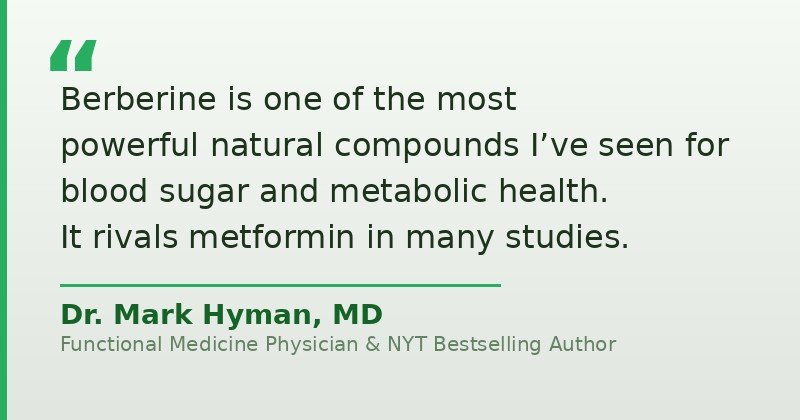
Dr. Hyman's own supplement line (GlucoSupreme Herbal) includes berberine alongside cinnamon — the same combination found in GlycoPezil™.
In Dr. Hyman's own supplement line, berberine is a primary ingredient, paired with cinnamon and other botanicals. His endorsement is not anecdotal — it is grounded in the same clinical literature we explore below. He has called it "one of the most underutilized tools in metabolic medicine" and routinely recommends it as a first-line natural intervention before patients move to prescription therapy.
Clinical Evidence: What the Research Really Shows (2022–2026)
The evidence base for berberine is unusually robust for a natural supplement. Here is a summary of the most significant recent research:
The 2022 Frontiers in Pharmacology Meta-Analysis
Researchers analyzed 37 randomized controlled trials involving 3,048 patients with type 2 diabetes. Berberine reduced fasting plasma glucose by 0.82 mmol/L, HbA1c by 0.63%, and 2-hour postprandial blood glucose by 1.16 mmol/L — all statistically significant. Crucially, berberine did not significantly increase the risk of hypoglycemia versus placebo.
2025 JAMA Network Open Phase 2 Trial
A landmark phase 2 trial tested berberine ursodeoxycholate (HTD1801) against placebo in overweight adults with type 2 diabetes over 12 weeks. The high-dose group achieved: HbA1c drop of 1 full percentage point, fasting glucose reduction of ~20 mg/dL, and post-meal glucose reduction of ~23 mg/dL — results that "approached the efficacy of common diabetes drugs like metformin," according to the researchers.
2025 Berberine + Cinnamon Combination RCT
A randomized placebo-controlled trial found that combining berberine and cinnamon over 12 weeks significantly reduced fasting blood sugar, HbA1c, and LDL-C compared to placebo — the same combination used in GlycoPezil™. The synergy between these two ingredients produced superior results to either alone.
| Study / Source | Participants | Duration | Key Finding |
|---|---|---|---|
| Xie et al., 2022 (Meta-analysis, Front. Pharmacology) | 3,048 (T2DM) | Various | HbA1c −0.63%, FPG −0.82 mmol/L, 2hPBG −1.16 mmol/L |
| JAMA Network Open Phase 2 RCT, 2025 | Overweight adults w/ T2DM | 12 weeks | HbA1c −1.0%, FPG −20 mg/dL vs. placebo |
| Berberine + Cinnamon RCT, 2025 | T2DM patients | 12 weeks | Significant ↓ FBS, HbA1c, LDL-C vs. placebo |
| Wei et al. (Meta-analysis, 46 trials) | Multi-trial aggregate | Various | ↓ FPG, HbA1c, TG, LDL; ↑ HDL cholesterol |
| Wang et al., 2021 (Front. Endocrinology) | Animal model (prediabetes) | 12 weeks | Slowed T2DM progression; improved gut microbiome via GLP-2 |
Berberine vs. Metformin: An Honest Comparison
The most cited comparison in berberine research is with metformin — the world's most prescribed diabetes drug. Multiple head-to-head studies have found that berberine produces similar reductions in fasting blood sugar and HbA1c, with a different side-effect profile and some additional metabolic benefits.
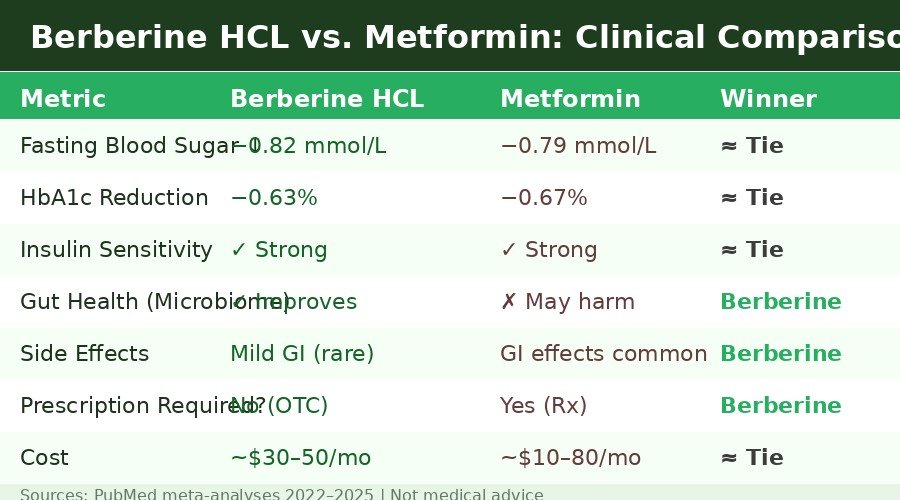
Clinical head-to-head data: berberine and metformin show near-identical glucose-lowering effects, but berberine wins on gut health, cholesterol, and accessibility.
| Category | Berberine HCL | Metformin (500–2,000 mg/day) |
|---|---|---|
| Fasting Blood Sugar | −0.82 mmol/L average | −0.79–1.0 mmol/L average |
| HbA1c Reduction | −0.63% average | −0.6–1.2% (dose-dependent) |
| AMPK Activation | ✅ Yes | ✅ Yes (same pathway) |
| Gut Microbiome | ✅ Improves (prebiotic-like) | ⚠️ May reduce beneficial bacteria |
| LDL Cholesterol | ↓ Significantly | Modest effect only |
| Triglycerides | ↓ Significant reduction | Modest effect only |
| GI Side Effects | Mild (take with food) | ⚠️ Common (nausea, diarrhea) |
| Hypoglycemia Risk | Low (not significantly ↑) | Low (used alone) |
| Vitamin B12 Depletion | No known depletion | ⚠️ Reduces B12 long-term |
| Prescription Required | No — OTC supplement | Yes — requires Rx |
| Average Monthly Cost | ~$30–50 | ~$10–80 (with Rx) |
⚠️ Important Safety Note
This comparison is for educational purposes only. Berberine is a supplement, not a replacement for prescription medication. Always consult your doctor before changing your diabetes management plan — especially if you take insulin or oral hypoglycemics, as berberine may enhance their effects and require dose adjustment.
5 Mechanisms: How Berberine Works in the Body
Berberine does not work through a single pathway. It is a multi-target compound, which explains why its effects are so broad and consistent across different patient populations.
AMPK Activation — "The Exercise Molecule"
Berberine's most studied mechanism is activating AMP-activated protein kinase (AMPK). When AMPK fires, it improves insulin sensitivity, drives glucose into cells for energy, and blocks the liver from producing new glucose. This is the same mechanism used by metformin — which is why their blood sugar effects are so similar.
Reduction of Hepatic Gluconeogenesis
In type 2 diabetes, the liver continues producing glucose even when blood sugar is already elevated — a major cause of high fasting readings. Berberine inhibits two key enzymes in this process (PEPCK and G6Pase), dramatically reducing "fasting glucose dumping."
Gut Microbiome Optimization
Research in Frontiers in Endocrinology (2021) found berberine slowed prediabetes progression by enhancing secretion of GLP-2 and improving gut bacteria composition. The gut-glucose axis is now recognized as a major metabolic pathway — and berberine is one of the few natural compounds that actively improves it.
Insulin Receptor Upregulation
Berberine increases the expression of insulin receptors on cell surfaces, making cells more responsive to the insulin already present. This is particularly valuable in type 2 diabetes, where insulin resistance — not lack of insulin — is the core problem.
Anti-Inflammatory & Antioxidant Action
Chronic low-grade inflammation drives insulin resistance. Berberine reduces key inflammatory markers (TNF-α, IL-6, CRP) while lowering oxidative stress — two factors that directly impair insulin signaling. This also helps protect pancreatic beta cells from damage over time.
Optimal Dosage & Timing: What Research Recommends
| Goal | Recommended Dose | Timing | Min. Duration |
|---|---|---|---|
| Blood sugar support (general) | 500 mg, 2×/day | With meals | 8 weeks |
| Active type 2 diabetes management | 500 mg, 3×/day (1,500 mg total) | With meals | 12 weeks |
| HbA1c reduction target | 1,000–1,500 mg/day, divided | With largest meals | 12 weeks |
| Prediabetes prevention | 500 mg, 2×/day | With meals | 3–6 months |
💡 Pro Tip From the Research
Berberine is best absorbed when taken with a meal containing some fat. Taking it on an empty stomach increases GI side effects and reduces absorption. Many practitioners recommend cycling: 8 weeks on, 2–4 weeks off, to maintain the compound's effectiveness long-term.
Side Effects & Who Should Use Caution
| Side Effect | Frequency | How to Minimize |
|---|---|---|
| Nausea / GI discomfort | Most common (especially week 1) | Always take with food; start at lower dose |
| Loose stools / diarrhea | Occasional | Split into smaller doses; take with food |
| Constipation | Less common | Ensure adequate hydration and fiber intake |
| Hypoglycemia (low sugar) | Rare — only if combined with diabetes meds | Monitor glucose; inform your doctor |
| Drug interactions | Possible with anticoagulants, CYP enzymes | Consult physician before combining |
Who should avoid or use caution:
- Pregnant or breastfeeding women (avoid — may affect fetal development)
- People taking warfarin or blood thinners (possible interaction)
- Those on metformin or insulin (monitor blood sugar closely with your doctor)
- People taking cyclosporine, tacrolimus, or certain antibiotics (CYP3A4/CYP2D6 interaction)
How Fast Can You Expect Results?
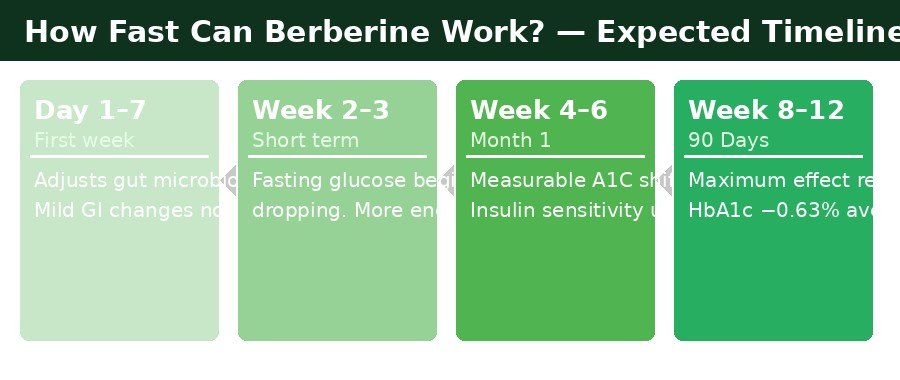
Berberine's effects build progressively — most users see meaningful fasting glucose changes by weeks 2–3, with peak HbA1c effects at 8–12 weeks.
Days 1–7: Gut & Cellular Adjustment
Gut microbiome begins shifting. AMPK pathway starts activating. Mild GI changes are normal this week. Some users notice slightly more stable energy after meals.
Weeks 2–3: Fasting Glucose Starts Dropping
Hepatic gluconeogenesis begins to reduce. Insulin receptor expression increases. Fasting glucose readings typically start trending down. Fewer post-meal energy crashes.
Weeks 4–6: Measurable Improvements
Full AMPK activation. Inflammatory markers declining. Most users see clear improvements in fasting glucose numbers. Weight may begin to decrease as insulin resistance improves.
Weeks 8–12: Peak Cumulative Effect
Maximum benefit reached. Lab work at 12 weeks should reflect significant improvement in HbA1c (average −0.63% across 3,048 patients in the 2022 meta-analysis). Cholesterol and triglycerides typically improved as well.
GlycoPezil™: Berberine + 3 Synergistic Partners
While standalone berberine is impressive, research consistently shows that combining it with complementary ingredients produces superior results. GlycoPezil™ was formulated around this principle, pairing Berberine HCL with three clinically supported co-ingredients — the same combination Dr. Hyman and others recommend.
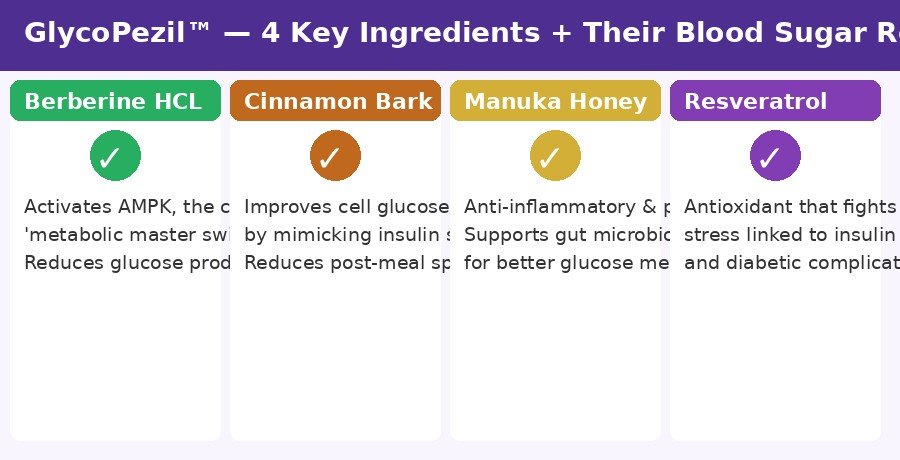
GlycoPezil™ addresses blood sugar through four distinct pathways simultaneously — a multi-mechanism approach that single-ingredient products cannot replicate.
🌿 Berberine HCL
The anchor ingredient. Activates AMPK, reduces hepatic gluconeogenesis, improves insulin receptor sensitivity. The most clinically studied natural compound for blood sugar.
★★★★★ High Evidence🌿 Cinnamon Bark Extract
Mimics insulin signaling, driving glucose into cells. Reduces post-meal spikes. The 2025 RCT combining berberine + cinnamon showed superior results to either alone.
★★★★☆ Strong Evidence🍯 Manuka Honey
Anti-inflammatory prebiotic that supports the same gut microbiome berberine targets. Provides natural energy without glucose spikes. Low glycemic impact.
★★★☆☆ Moderate Evidence🍇 Resveratrol
Potent antioxidant that reduces oxidative stress linked to insulin resistance. Protects pancreatic beta cells and reduces inflammatory markers that impair insulin signaling.
★★★★☆ Growing EvidenceThis combination directly mirrors the protocol that clinical researchers have found most effective: berberine as the core blood sugar regulator, cinnamon for post-meal spike control, gut support for microbiome optimization, and antioxidants for long-term cellular protection and beta cell health.
Experience the Berberine Difference
GlycoPezil™ delivers clinically studied Berberine HCL + 3 synergistic co-ingredients in one complete daily formula. Limited-time special pricing available.
Claim Your Discount →60-Day Satisfaction Guarantee · Free Shipping Available · 100% Natural Formula
Frequently Asked Questions
📚 Continue Reading
→ Berberine for Blood Sugar: Benefits, Side Effects & What Research Really Says
→ Chromium for Blood Sugar Control: Benefits, Dosage & Does It Work?
→ How to Lower A1C Naturally: 7 Evidence-Based Strategies (2026)
→ Best Blood Sugar Supplements (2026): Ranked by Clinical Evidence
→ Manuka Honey & Blood Sugar: The Science Explained
→ 5 Daily Habits That Stabilize Blood Sugar All Day
Looking for a natural formula with Berberine HCL + Cinnamon + Manuka + Resveratrol?
Visit GlycoPezil™ Official Site →